






Kindly Sponsored by:
Human Intelligence meets Artificial Intelligence
Reflections from the BPCC Brainstorming Lunch, Alfama, Lisbon
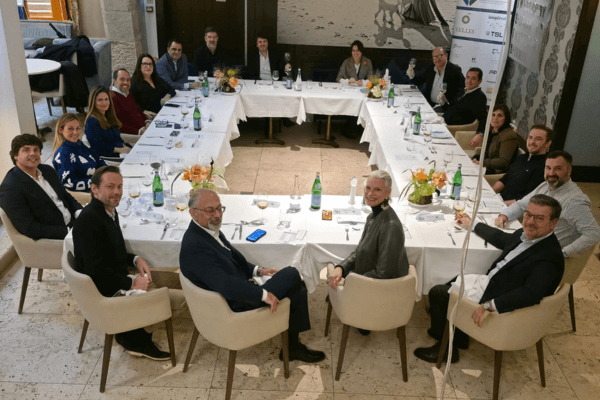
On 21 January 2026, in Alfama, Lisbon, a group of leaders from very different professional backgrounds gathered around a common question: how can companies identify and attract C-level leaders who are genuinely equipped to guide organisations that are experimental, curious and ready to integrate AI into everyday operations?
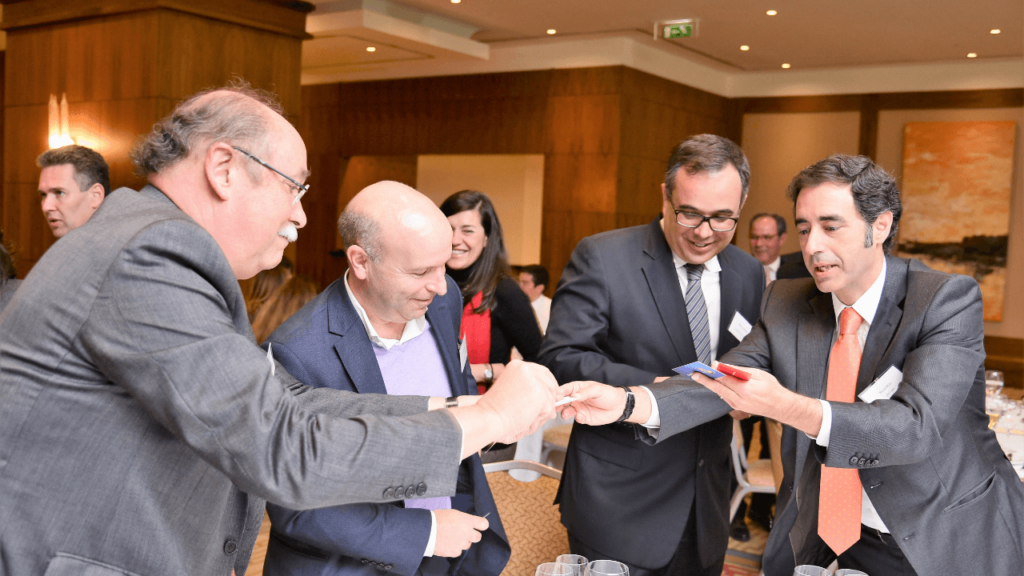
There was something quietly symbolic about the setting. We met physically, face to face, in one of Lisbon’s most historic quarters, to talk about Artificial Intelligence. Handshakes, eye contact, informal exchanges before sitting down at the table – human intelligence coming together to discuss artificial intelligence. And perhaps this already foreshadowed one of the central themes of the discussion: technology may reshape how we work, but it does not eliminate the deeply human dimensions of leadership, trust and decision-making.
The group itself mirrored this productive tension. On one side were representatives from the recruiting and executive search world – those who identify, assess and recommend leaders. On the other side were business leaders and operators, those who live the reality of C-level responsibility every day. This combination allowed the discussion to move well beyond theory and into very practical territory.
A large part of the conversation focused on the future of executive selection processes and the role AI can and should play within them. There was a surprisingly strong convergence around one idea: the path towards the interview can, and likely should, become highly AI-driven. Screening CVs, mapping career patterns, identifying potential, comparing profiles at scale, reducing unconscious bias – in all these areas, AI already offers advantages in speed, breadth and consistency that human processes struggle to match. Several participants even suggested that the pre-selection phase might one day become almost entirely automated.
However, the discussion shifted decisively when it came to the moment of final choice. When deciding whether one genuinely wants to work with someone at C-level – whether there is cultural fit, mutual trust, positive chemistry, the ability to challenge and be challenged – the room was almost unanimous: this remains a deeply human process. Many stressed that even video interaction is often insufficient for such decisions. Physical presence, the way someone enters a room, listens, reacts under subtle pressure, or handles discomfort, still carries information that no algorithm can reliably replicate today. In that sense, AI may become the gatekeeper, but not the judge.
From there, the discussion naturally expanded to the broader question of how AI is changing professions and roles more fundamentally. The medical field became a particularly vivid example. It was provocatively suggested that doctors may one day cease to be a “human” profession, as machines, robots and AI systems increasingly outperform humans in diagnostics, surgery and treatment precision. Yet this view was not left unchallenged. While participants readily acknowledged that AI already supports diagnosis, identifies treatment options across vast data sets, and enables robotic surgeries of remarkable precision, many insisted that something essential remains human: care, reassurance, responsibility, and the ability to navigate uncertainty alongside another human being. Even where machines outperform technically, the meaning of being human in medicine – and by extension in leadership – remains intact.
This led directly to the question of what kind of leaders organisations will need in the future. There was broad agreement that future C-level executives must be at least tech-savvy. Not necessarily engineers or programmers, but sufficiently fluent to understand what AI does, where its limits lie, and how it reshapes governance, decision-making, accountability and power structures within organisations. Several voices were quite clear: leaders who are not digitally fluent will not fail because they are bad leaders, but because they will increasingly be unable to see what is happening around them.
At the same time, a sobering observation emerged: despite the intensity of public discourse around AI, even many tech companies and AI-focused organisations are still far from using AI systematically in their own governance, management processes and internal operations. AI is often showcased outwardly, yet only partially embedded where it really matters – in structure, power, decision rights and accountability. There is, as of today, more self-promotion about AI than true organisational integration.
In this sense, the lunch did not conclude with certainty about what the near future will bring. Quite the opposite. What emerged was a shared understanding that uncertainty itself has become a defining feature of leadership in the age of AI. The challenge is no longer to eliminate ambiguity, but to navigate it responsibly, with judgement, humility and openness to learning.
In the end, the discussion did not reduce leadership to technology, nor did it romanticise the human factor. Instead, it clarified the evolving relationship between the two: technology will profoundly reshape how we lead, how we select leaders and how organisations function. But humanity will continue to determine why we lead, for whom we lead, and what kind of societies we ultimately want to build.
Perhaps this is the most valuable outcome of our exchange in Alfama: a shared conviction that the future of leadership will not be decided by artificial intelligence alone, nor by human intuition in isolation, but by the quality of the dialogue between the two.
Text:
Ferdinand Lucke
| Individual | Company | URL |
| Cláudio Menezes | Damia Group | www.damiagroup.pt |
| Ferdinand Lucke | 2Leadership | www.2leadership.org |
| Fernando Reino da Costa | Unipartner | www.unipartner.com |
| Francisco Sanchez | Odgers Berndtson | www.odgersberndtson.com |
| Gonçalo Valente | JLL | www.jll.pt |
| Greg Stoos | AISO Hub | https://aiso-hub.com/ |
| James Horrocks | Inscale | www.inscale.net |
| João Pereira de Faria | Burson | www.bursonglobal.com |
| Luís Silva | Pedra Silva Arquitectos | www.pedrasilva.com |
| Mário Gonçalves | HAYS | www.hays.pt/ |
| Mário Vinhas | MDS | www.mds.pt |
| Patrícia Pereira | Pernod Ricard | www.pernod-ricard.com |
| Sandrine Veríssimo | HAYS | www.hays.pt/ |
| Sofia Ramos | Travelstore / Embrace | www.embraceambition.com |
| Susana Miranda | Susana Miranda Group | www.susana-miranda.com |
| Swapan Kumar | Brightman Group | www.brightmangroup.com |
| Anne Brightman | Brightman Group | www.brightmangroup.com |
| Teona Omiadze | Bridge In | www.bridgein.pt |
| Chris Barton | BPCC | www.bpcc.pt |